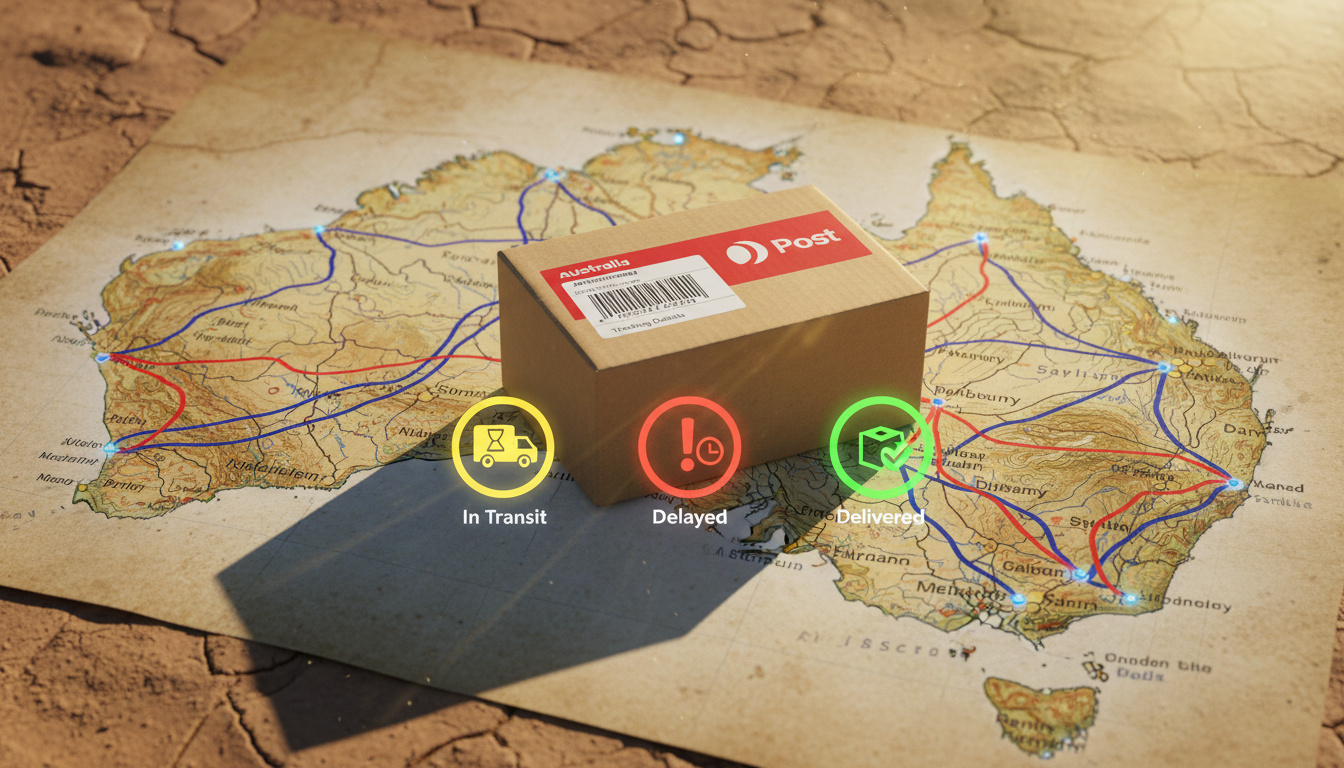
Australia Post tracking provides real-time visibility into domestic and international parcel movements through a standardized 13-character reference system. The national carrier handles millions of items monthly, offering digital tools that update every few hours as shipments progress from dispatch to final delivery.
Customers retrieve tracking numbers from receipts, email confirmations, or barcode labels to monitor progress via web portals or mobile applications. The process applies equally to standard parcels sent across metropolitan areas and international packages crossing customs borders.
Understanding format specifications, status definitions, and support channels ensures accurate delivery expectations. This guide examines the technical structure of AusPost tracking references, common delay factors, and official resolution pathways.
How Do I Track My Australia Post Parcel?
Locating a parcel requires the unique identifier assigned at lodgement. Australia Post employs distinct formats depending on service type, with international and standard domestic parcels utilizing a 13-character code typically ending in “AU”. Access the official Australia Post tracker to initiate monitoring.
| Official Tracker Web portal at auspost.com.au/receiving/tracking-service |
Tracking Format 13 characters (e.g., XX123456789AU) |
| MyPost Account Monitor up to 10 numbers simultaneously |
Mobile Access Free iOS and Android applications available |
- International shipments display progress through Australian customs using the 13-character format ending in “AU”, according to FreightAmigo logistics documentation.
- Domestic tracked letters utilize a complex 25-character string beginning with “TM” and incorporating DPID data, as specified in official imprint specifications.
- Tracking events commence only after physical dispatch, not at order placement.
- The MyPost dashboard accommodates simultaneous monitoring of up to ten distinct consignments.
- Mobile applications provide automated notifications when customers include email addresses or mobile numbers in shipping manifests.
- Incorrect label formatting frequently generates sorting delays, particularly when DPID routing information is omitted from barcodes.
- Parcels requiring investigation for lodgement or barcode issues route through dedicated Lodgement Tech Support channels.
| Service Category | Format Structure | Typical Transit | Update Frequency |
|---|---|---|---|
| International Parcels | 2 letters + 9 digits + AU | 5-14 days | Every few hours |
| Domestic Standard | 13 characters | 2-5 business days | Event-based |
| Domestic Express | 13 characters | 1-2 business days | Real-time available |
| Tracked Letters | 25 characters (TM prefix) | Variable | Scan-based |
| MyPost Capacity | Up to 10 numbers | N/A | Simultaneous view |
| Notification Triggers | Email/Mobile in manifest | Immediate | Push notification |
What Do Australia Post Tracking Statuses Mean?
Event descriptions vary by selected service tier, with Parcel Post and Express Post generating distinct scan sequences. Understanding specific terminology prevents misinterpretation of transit stages.
What Does “Out for Delivery” Indicate?
The status “out for delivery” signifies the item has left the local distribution facility and currently resides with the delivery driver for final address distribution. This designation appears during the terminal phase of transit, typically within hours of physical arrival.
“Out for delivery” definitively means the local carrier possesses the item, not that it awaits pickup at a facility. Residential deliveries usually complete the same day this status appears, barring access issues or security constraints.
Why Do Tracking Updates Stall?
Non-updating tracking usually indicates the parcel has not reached the next scanning checkpoint. Events lag based on lodgement method and service type, with some stages generating scans only at origin and destination rather than intermediate facilities.
Why Is My Australia Post Parcel Delayed and How Long Does Delivery Take?
Delivery windows fluctuate based on origin-destination pairs, selected service speed, and seasonal volume spikes. Rural routes typically require additional transit days compared to metropolitan corridors.
Common Delay Factors
Incorrect or incomplete addressing represents the primary source of sorting delays. Official parcel preparation guidelines mandate black ink on white backgrounds, prohibition of bold or italic fonts, and mandatory inclusion of DPID routing data within barcodes. Labels featuring commas or improper formatting trigger manual processing queues.
Address validation software helps prevent delays. Labels must display complete addresses with postcodes in standard fonts—deviations force manual sorting that extends transit by 24-72 hours.
Expected Service Standards
Domestic Parcel Post typically achieves delivery within two to five business days, while Express Post reduces this to one to two days for eligible postcodes. International timeframes span five to fourteen days depending on destination country customs protocols.
Australia Post Tracking Tools and Support Options
Multiple digital entry points accommodate different user preferences, from anonymous single-number lookups to registered account dashboards with notification management.
MyPost App and Web Portals
The MyPost tracking interface permits free registration and supports monitoring up to ten consignments simultaneously. Users accessing the standalone tracking service require no login credentials for basic status retrieval.
Overseas shipments utilize identical tracking tools despite crossing international borders. The 13-character format ending in “AU” integrates seamlessly into domestic scanning systems upon arrival in Australia.
Support Escalation Pathways
Technical issues involving lodgement or barcode generation require contact with Lodgement Tech Support rather than general customer service. Account managers handle bulk business inquiries, while individual senders should verify tracking number formatting before escalating.
How Does a Parcel Progress Through the Australia Post Network?
The operational sequence follows standardized logistics stages from acceptance to final handoff.
- Lodgement: Sender hands item to postal staff or deposit box; tracking activates upon facility scanning.
- Processing: Parcel undergoes automated sorting using barcode routing data; DPID validation occurs here.
- In Transit: Item moves between distribution centers via road or air transport; scans update at each facility entry.
- Out for Delivery: Local carrier loads item for final address delivery; status appears morning of delivery day.
- Delivered: Item reaches recipient or secure location; GPS confirmation and signature may be captured.
What Is Definite and What Remains Uncertain About Australia Post Tracking?
Clear distinctions exist between verified technical specifications and variable operational factors.
| Established Information | Uncertain or Variable Factors |
|---|---|
| International parcels use 13-character codes ending in “AU” | Exact delivery hour varies by local volume and routing |
| “Out for delivery” means the item is with the local carrier | Current delay statistics for specific regions not publicly detailed |
| Tracking updates require proper DPID inclusion in barcodes | Real-time GPS positions of delivery vehicles unavailable |
| MyPost accommodates 10 simultaneous tracking numbers | Precise customs clearance durations for international items |
How Does Australia Post Tracking Fit Within National Infrastructure?
The tracking system integrates with the national delivery point identifier (DPID) database, an 8-digit routing code embedded within barcodes to streamline automated sorting. This infrastructure supports both urban retail locations like Coles Bacchus Marsh – Address, Hours, Phone, Services and rural distribution networks. For more details on this topic, you can refer to Sophia Hutchins death Caitlyn Jenner claims.
Australia Post operates as the designated universal service provider, maintaining statutory obligations to serve all Australian addresses while competing with private courier services. The tracking technology bridges physical logistics and digital commerce, connecting with financial planning tools through integrated lifestyle management platforms.
Environmental factors and seasonal demand peaks influence scanning frequency, though the underlying technical specifications remain constant across states and territories.
What Do Official Documents Specify About Tracking Protocols?
Technical standards reside in publicly available specification sheets governing label printing and barcode generation.
Domestic letter tracking imprints require Helvetica or Arial 9pt font, with the 25-character string formatted as ‘TM’ followed by a 6-character Customer Reference ID, 5-digit Sub Product identifier, 9-digit Sequence Number, 2-digit Service Code, and Check Digit, spaced every five characters.
— Australia Post Domestic Letter with Tracking Imprint Specifications
Parcel and freight labels must utilize black ink on white backgrounds without bold, italics, or commas, and must include the full address with postcode to ensure proper DPID routing.
— Australia Post Parcel and Freight Preparation Guide
Final Takeaways on Australia Post Tracking
Australia Post tracking relies on standardized 13-character reference numbers for parcels and 25-character strings for tracked letters, accessible via the MyPost platform, mobile applications, or anonymous web tools. While delivery times range from same-day Express to two-week international windows, accurate label formatting with proper DPID inclusion remains essential for predictable tracking updates. For additional financial planning resources, see ANZ Home Loan Calculator – Guide to Features and Accuracy.
Frequently Asked Questions About Australia Post Tracking
Does Australia Post tracking work for international parcels?
Yes. International shipments use the same 13-character format ending in “AU” and integrate into domestic systems upon arrival in Australia.
What if my tracking number is invalid?
Verify the format matches two letters, nine digits, and “AU”. Re-enter carefully without spaces. If lodged recently, allow 24 hours for activation.
Can I track a parcel without a MyPost account?
Yes. The standalone tracking service at auspost.com.au/receiving/tracking-service requires no login for single-number lookups.
What does the DPID mean on my label?
The Delivery Point Identifier is an 8-digit routing code within barcodes that directs parcels to specific addresses during automated sorting.
How do I get notifications for my parcel?
Include your email or mobile number in the shipping manifest. The MyPost app also offers push notifications for saved tracking numbers.
Why has my tracking not updated for several days?
Events lag between scans, especially during transit between major facilities. Some services only scan at origin and destination points.
Where do I find my tracking number?
Check receipts, email confirmations, barcode labels, or invoices from the sender. The number appears beneath the barcode on physical labels.
Related stories





Liam O'Brien covers Australian politics and public affairs for Southern Pulse.